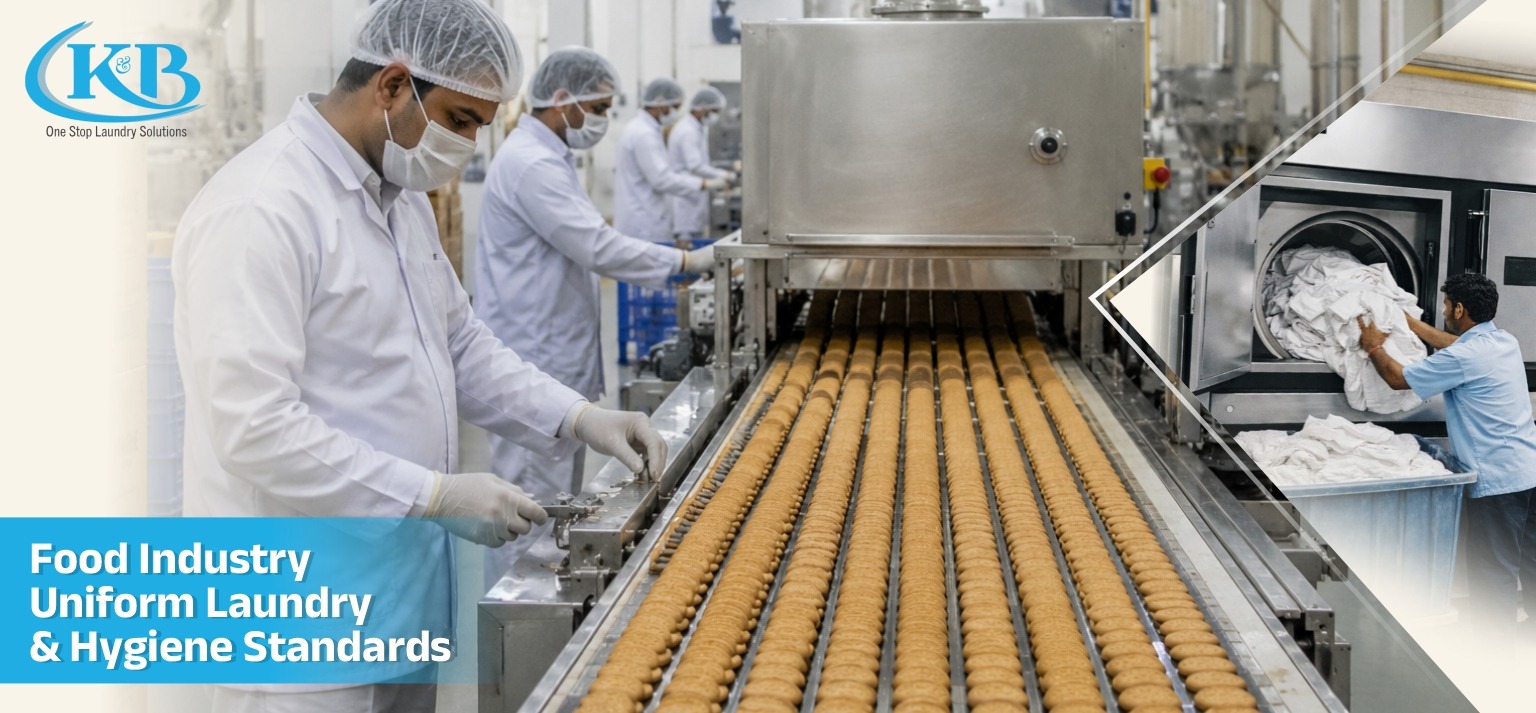
When food safety auditors inspect a manufacturing facility, they don’t just evaluate machinery and production areas. Workwear hygiene is equally critical because contaminated uniforms can directly compromise food safety.
If your staff uniforms are being washed using domestic washing machines, outsourced local laundry services, or unmanaged processes, there’s a high chance your facility is not fully compliant with FSSAI, BRC, or ISO 22000 expectations.
K&B Associates works with major food industry clients including Parle Biscuits and Britannia, where strict hygiene standards are mandatory. The difference between compliant and non-compliant facilities often comes down to how seriously they treat laundry operations.
Why Uniform Laundry Compliance Matters in Food Manufacturing
The 3 Major Contamination Risks from Improper Uniform Washing
1. Biological Contamination
Harmful bacteria such as E. coli, Salmonella, and Staphylococcus aureus can survive on improperly washed garments. Domestic washing temperatures are often too low to reliably eliminate these pathogens.
In food production environments, even minor contamination from sleeves, gloves, or aprons can become a serious safety incident.
2. Chemical Contamination
Using incorrect detergents or failing to rinse garments properly can leave behind chemical residues that transfer to food products through direct or indirect contact.
Food-grade laundry chemicals and controlled dosing systems are essential for maintaining safe hygiene standards.
3. Physical Contamination
Damaged or poorly maintained uniforms shed fibres, threads, and particles. In food factories, these become foreign-body contamination risks that can lead to rejected batches, customer complaints, or costly recalls.
What FSSAI and BRC Auditors Expect
Food safety audits increasingly evaluate laundry processes as part of overall hygiene management. Common compliance requirements include:
- Clean uniforms for every shift — Staff workwear must be hygienically maintained and regularly replaced
- Cross-contamination prevention — Dirty garments and clean garments must remain physically separated
- Food-safe chemicals — Detergents and sanitisers should meet food-industry standards
- Process documentation — Washing schedules, garment issue records, and SOPs should be maintained
- Validated hygiene process — BRC standards often require proof that the wash process effectively reduces microbial contamination
— Quality Manager, Food Processing Unit, Pune
Recommended Laundry Equipment for Food & Pharma Industries
Compliance-focused facilities generally use dedicated commercial laundry systems designed specifically for industrial hygiene applications.
- High-temperature washer extractors capable of sustained 60°C+ wash cycles
- Automatic chemical dosing systems for consistent detergent and sanitiser control
- Commercial tumble dryers with controlled airflow and hygienic drying
- Separate clean and dirty zones inside the laundry room to prevent recontamination
- Stainless steel industrial equipment for durability and hygiene compliance
Why More Food Factories Are Moving In-House
Outsourcing workwear laundry may appear convenient, but it creates major gaps in traceability, process control, and hygiene documentation.
In-house laundry systems allow factories to maintain complete control over washing temperatures, chemical usage, garment handling, and hygiene records — all critical during food safety audits.
K&B Associates helps food manufacturers across India design compliant laundry rooms with commercial equipment, workflow planning, SOP guidance, and maintenance support.
Check Whether Your Laundry Process Is Compliant
Our team assesses your current uniform washing process against FSSAI and food-industry hygiene standards and recommends practical improvements.


